I remember standing in a drafty leisure centre back in the nineties, watching a lad try to play a standard wing-back transition on a court no bigger than a local primary school’s assembly hall. He was looking for the wide channels, the overlapping runs, and the long diagonal balls that make a Sunday league match on a muddy pitch look like a tactical masterpiece. He looked utterly lost. It’s the same mistake I see every time a coach thinks they can just transplant their grass-pitch philosophy onto a hard floor; they don’t realize that understanding how futsal differs from football isn’t about learning new rules, it’s about accepting that the physics of the game have fundamentally changed.
I’m not here to give you a lecture on the history of the sport or some expensive, color-coded tactical theory that only works in a textbook. I’m going to tell you why your players will panic when they realize they can’t hide behind a striker, and why that heavy, rolling ball they’re used to is suddenly their worst enemy. We’re going to strip away the jargon and look at the brutal realities of space, tempo, and contact. If you want the truth about what actually works when the floor is hard and the room is tight, you’ve come to the right place.
Pitch Dimensions Comparison Why Space Is a Luxury You Cant Afford
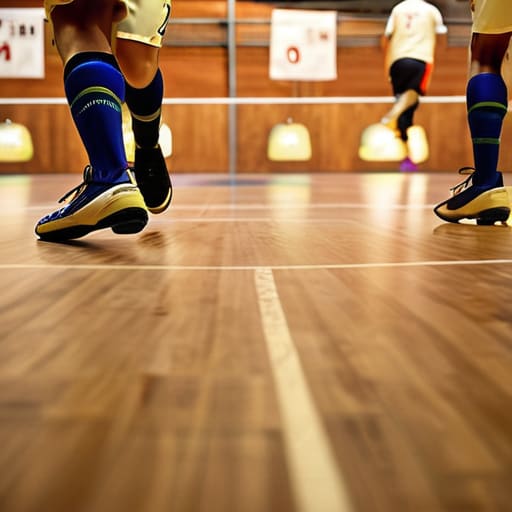
If you take a group of lads used to sprinting sixty yards into open space and drop them onto a futsal court, they’re going to have a collective panic attack. On a standard grass pitch, you can afford to be a bit lazy with your positioning; you’ve got time to turn, look up, and scan the horizon. In futsal, that luxury is gone. The pitch dimensions comparison isn’t just about a smaller area; it’s about the fact that the boundary lines are constantly breathing down your neck. You aren’t playing with room to breathe; you’re playing in a pressure cooker where every inch of space is contested.
Because the court is so cramped, the futsal tactical differences become immediately apparent. You can’t rely on long, sweeping diagonal balls to bypass a midfield. Instead, the game becomes a relentless cycle of short, sharp movements. You’ll find that players who rely on pure pace often struggle here, whereas those with high-level indoor soccer technical skills—the ability to manipulate the ball in tight quarters—will thrive. It’s a different kind of geometry entirely, one where the walls are closer and the margin for error is practically non-existent.
Futsal Ball Size and Weight the Physics of Control

Now, don’t go thinking a ball is just a ball. If you walk onto a futsal court with a standard size five match ball, you might as well be trying to play chess with a sledgehammer. A regular football is designed to bounce; it’s built to fly through the air and skip off the turf. In futsal, we use a size four ball that is specifically weighted to be “low-bounce.” It’s heavier, denser, and stays glued to the floor.
This isn’t just a minor tweak in futsal ball size and weight; it fundamentally changes the physics of the game. Because the ball doesn’t skitter away from you every time it hits a seam or a crack, players are forced to develop impeccable close control. You can’t just hoof it long and hope for the best. You have to learn to manipulate the ball with the sole of your foot, keeping it under your thumb in tight quarters. This is where real player development through futsal happens—it teaches them that if they want to keep possession, they have to master the art of the touch, not just the art of the kick.
Five Hard Truths About Transitioning from Grass to the Court
- Stop looking for the long ball. In football, you can loft a ball sixty yards to bypass a midfield; in futsal, that’s just handing the ball to the opposition. The space is too tight and the floor is too hard. If you try to play “route one” on a court, you aren’t being direct, you’re just being reckless.
- The sole of the foot is your best friend, not an afterthought. On a grass pitch, you’re usually playing with the inside or outside of the boot to keep the ball moving. In futsal, if you aren’t using the sole to trap and roll the ball, you’re going to find yourself constantly tripping over it. It’s about control in a space where you have zero time to settle.
- Forget the “stay in your position” nonsense. In football, you have lanes and zones; in futsal, if you stand still, you’re dead. The game is constant rotation. If your winger stays glued to the touchline, they’re effectively playing with ten men. You have to move to create the passing lanes, not just wait for them to appear.
- Defending is about body shape, not just tackling. On a big pitch, you can jockey a player for ten yards. On a futsal court, the moment you overcommit or lung at a ball, the attacker is past you and the goal is staring them in the face. You defend with your feet and your eyes, staying low and ready to react to the immediate turn.
- Fitness isn’t about running five miles; it’s about surviving the repeated sprints. I see coaches try to train futsal players with long, slow jogs. That’s a waste of time. Futsal is a series of high-intensity bursts followed by a momentary recovery. If your players can’t recover their breath in those ten seconds of dead ball, they’ll be useless by the second half.
The Reality Check: Three Things You Can't Ignore
Stop trying to play long-ball football; on a futsal court, if the ball isn’t on the floor and controlled, you’ve already lost it.
Forget your usual running patterns; the game isn’t about covering distance, it’s about explosive, short-burst movements and constant repositioning.
Respect the ball’s weight; that low-bounce futsal ball isn’t a mistake, it’s a tool that demands better touch and smarter passing than the heavy, bouncing thing you’re used to on grass.
The Reality Check
At the end of the day, you can’t just take your Sunday League habits and expect them to work on a futsal court. We’ve looked at the dimensions, the heavier ball, and the lack of room to breathe, but the real lesson is about adaptability. If you try to play a long-ball game or rely on sprinting into open channels that don’t exist, you’re going to get punished. Futsal isn’t a “smaller version” of football; it is a different beast entirely that demands instantaneous decision-making and a much higher level of technical precision. You don’t have the luxury of a bad touch or a lazy pass when the walls are practically touching your shoulders.
If you are a coach, don’t look at futsal as a distraction from the “real” game. Look at it as the ultimate laboratory. It is where you strip away the noise and see if your players actually have the technical foundation to survive when the space disappears. Use it to sharpen their feet and their brains. Whether you’re standing in a muddy field in November or on a polished court in a sports hall, the goal remains the same: making sure your players can actually play when the pressure is on. Now, stop reading about it and get them moving.
Frequently Asked Questions
If the pitch is smaller and the ball is heavier, should I be changing my players' conditioning drills or just their technique?
You can’t pick one. If you only focus on technique, your players will be technically gifted but gasping for air by the second period. If you only focus on fitness, they’ll have lungs like bellows but no control over that heavier ball. Futsal demands “repeated sprint ability”—short, sharp bursts followed by immediate recovery. Don’t just run laps; run drills that force them to change direction, decelerate, and regain composure while their heart rate is through the roof.
Does the lack of an offside rule in futsal mean I can just park my defenders, or will that get me punished every single time?
If you try to park your defenders in futsal, you’re essentially inviting a slow death. In 11-a-side, the offside rule gives your backline a safety net; it lets them push up and compress the pitch. Without it, a clever attacker will just hover on your shoulder, waiting for a long ball to bypass your entire structure. You can’t sit deep—you’ll get carved open. You have to defend with movement and pressure, not just by standing in a line.
When transitioning from grass to the court, how much of my existing tactical setup can I actually keep, or am I starting from scratch?
Don’t throw your playbook in the bin just yet, but don’t expect it to work without a heavy edit. Your core principles—width, depth, and finding the free man—remain the same. However, that expansive 4-3-3 you love on a Sunday morning? It’ll get you slaughtered on a court. In futsal, everything is condensed. You aren’t playing positions; you’re playing roles. If you try to hold rigid lines, you’ll find yourselves static and easy to bypass.
