I’ve lost count of how many “elite” coaching manuals I’ve seen that suggest you need high-tech sensors or complex, isolated technical circuits to fix a player’s reliance on their dominant side. It’s nonsense. I once watched a young lad—talented enough to make a scout blink—get completely shut down in a cup semi-final simply because he refused to turn onto his left. He had the technique in a vacuum, but he didn’t have the bravery to use it when a defender was breathing down his neck. If you’re looking for a magic pill or a way to automate how to coach weak foot development through mindless repetition, you’re in the wrong place.
I’m not here to sell you on fancy terminology or expensive equipment that’ll end up gathering dust in the kit bag. What I am going to give you is the truth from thirty-five years on the touchline: how to bake that secondary foot into their game through chaos and decision-making. I’ll show you the drills that actually survive a wet Tuesday night when the kids are tired and the pitch is heavy, ensuring they don’t just learn to kick a ball, but learn to play without fear.
Neuromuscular Adaptation Training That Survives the Sunday Morning Slump
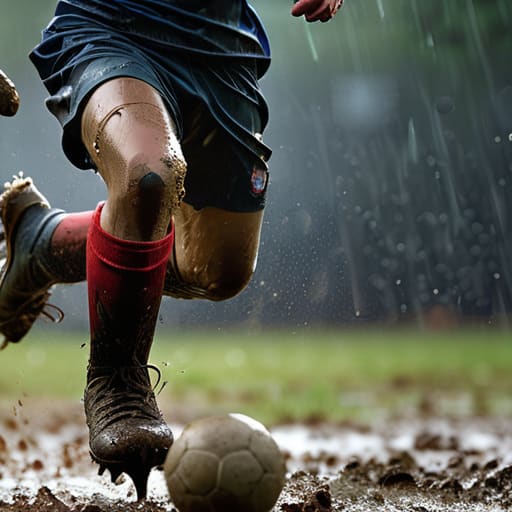
If you want a player to use their left foot when they’re eighty yards from goal and a defender is breathing down their neck, you can’t just have them standing in a line tapping a ball against a wall. That’s fine for a Tuesday night in a heated gym, but it won’t help them on a muddy pitch at 10:00 AM on a Sunday. You need to focus on neuromuscular adaptation training that actually forces the brain and the limb to talk to each other under stress. This means moving away from static repetition and moving toward chaos.
I’ve found that the best way to bridge the gap is through unilateral strength training integrated into your technical drills. If a player’s stabilizing muscles are weak, their brain will instinctively protect that limb by defaulting to the “safe” foot. Incorporate footwork coordination exercises that require a sudden change of direction or a single-leg balance before they even touch the ball. If they can’t find their center of gravity on one leg, they’ll never have the stability to execute a clean strike with the weaker one. Stop coaching the foot; start coaching the body that supports it.
Improving Ball Control When the Pressure Is on

The problem with most technical football drills is that they’re too polite. You set up a cone, have a player tap the ball between it with their left foot, and call it progress. That isn’t coaching; that’s just making sure they can hit a stationary object in a vacuum. In a real match, nobody gives them a moment to breathe, let alone a stationary ball. If you want to see actual improvement, you have to introduce a defender—even if it’s just a teammate shadowing them closely—to force that improving ball control to happen under duress.
Real soccer skill progression happens when the brain has to fight the body to make a decision. I’ve seen plenty of lads who look like magicians in a quiet training session, only to turn into statues the moment a mid-table winger lunges at them. To fix this, stop the repetitive, low-intensity patterns. Instead, move toward small-sided games with restricted touches, forcing them to use that non-dominant foot to navigate tight spaces. If they can’t control the ball while someone is breathing down their neck, they haven’t actually learned the skill; they’ve just memorized a movement.
Five ways to stop the excuses and actually get them using the other foot
- Stop the “isolated” repetition trap. If you spend twenty minutes having kids stand in a line just tapping a ball against a wall with their left foot, you’re wasting your time and theirs. They aren’t learning to play football; they’re learning to do a repetitive gym movement. You need to introduce a defender—even if it’s just a mannequin or a teammate walking slowly—within the first five minutes. If there’s no consequence for using the wrong foot, they’ll revert to their comfort zone the second a real opponent shows up.
- Force the decision, don’t just ask for it. Don’t tell them “use your left foot today.” Instead, set up your passing gates or small-sided games so that the natural angle of approach makes the dominant foot impossible to use. If they have to turn their body a certain way to get the ball through the gate, they’ll be forced to use the weak foot just to keep the play moving. Make the correct foot the path of least resistance.
- Fix the “toe-poke” habit. I see it every Sunday: a kid gets panicked, realizes they can’t use their strong foot, and just stabs at the ball with their toes to get it out of harm’s way. It’s a panic response. You have to drill the technical mechanics of the strike—the plant foot position and the follow-through—during low-stakes moments so that when the pressure rises, the muscle memory is about “shape” rather than “survival.”
- Use the “Two-Touch Rule” with a twist. In your small-sided games, implement a rule where they are allowed two touches, but one of those touches must be with the non-dominant foot. It sounds simple, but it forces them to stop thinking about the ball as a problem to be solved and starts treating the weak foot as a standard tool in the kit. It turns a conscious struggle into a subconscious requirement.
- Watch their body orientation, not just their feet. Most coaches yell “use your left!” when a player is stuck. That’s useless. Instead, look at their hips. If a player is squared up to the pitch, they’ll almost always default to their strong side. Teach them to open their hips early. If they can learn to orient their body to face the direction of play, the weak foot becomes a natural extension of their movement rather than a clumsy afterthought.
The Bottom Line: Stop Coaching, Start Forcing
Stop treating the weak foot as a separate lesson; if you aren’t integrating it into high-speed, chaotic drills where the player has no time to think, you aren’t training a skill, you’re just doing a dance routine.
Forget the idea of “perfect technique” in isolation—a weak-foot pass is only useful if it works when the player is tired, the pitch is heavy, and an opponent is breathing down their neck.
If you see a player instinctively turning onto their strong foot to avoid a challenge, don’t just correct them; change the drill so that the only way they can successfully escape the pressure is by using the foot they’ve been avoiding.
The Long Game
Look, we’ve covered a lot of ground, from getting the brain to talk to the feet through neuromuscular work to making sure they don’t panic when a defender is breathing down their neck. The takeaway is simple: you cannot coach a weak foot in a vacuum. If you’re just standing them in a line, hitting a ball against a wall while they stare at the clouds, you’re wasting your Saturday morning. You have to bridge the gap between isolated repetition and the absolute chaos of a real match. It’s about making the left foot—or the right, if they’re a lefty—a tool they can actually trust when the lungs are burning and the pitch is turning into a bog.
At the end of the day, developing a two-footed player isn’t about a magic drill you found on a glossy website; it’s about patience and persistence. You’ll see them fail. They’ll shank a sitter or pass it straight to the opposition, and they’ll look at you like you’ve asked them to perform surgery. Don’t panic. That’s just the sound of them learning. If you keep pushing them to make those difficult decisions under pressure, rather than letting them take the easy way out with their dominant side, you aren’t just coaching a skill—you’re building a player who can actually survive the game. Now, get out there and get stuck in.
Frequently Asked Questions
How do I stop the kids from subconsciously switching the ball back to their strong foot the second they feel a defender closing them down?
It’s a reflex. Their brain sees a defender and panics, defaulting to the “safe” foot because it’s the only one they trust under pressure. You can’t coach that out with static drills. You have to build “pressure tolerance.” Stop letting them play in wide-open spaces. Tighten the gates, shrink the pitch, and force them into 1v1 scenarios where the only way out is through the weak foot. If they don’t feel the heat, they’ll never use the foot.
If a player is genuinely struggling with coordination, am I wasting their time with high-intensity drills, or should I go back to the basics of stationary ball mastery?
If they’re stumbling over their own feet, stop throwing high-intensity chaos at them. You’re just teaching them how to fail faster. If the coordination isn’t there, the engine is revving but the gears aren’t catching. Pull them back. Give them stationary ball mastery—not just mindless tapping, but focused, rhythmic work. Build the neurological map first. Once they stop looking at their feet to find the ball, then, and only then, do we turn up the heat.
How much time should I actually carve out of a standard ninety-minute session for weak foot work before it starts affecting the tactical flow of the rest of the training?
Look, if you spend thirty minutes on isolated weak-foot drills, you’ve already lost them. You’ll have fourteen kids staring at their boots while the energy evaporates. I never dedicate more than ten to fifteen minutes to pure technical work. It needs to be a sharp, high-intensity block early on, or better yet, baked into your passing patterns. If you don’t weave it into the tactical flow, it’s just wasted time in a cold car park.
