I’ve spent more Sunday mornings than I care to admit standing on waterlogged pitches, watching well-meaning coaches pull out laminated, colour-coded tactical sheets as if they were delivering a lecture at Oxford. If you’ve been searching for a complete guide to coaching under tens that promises to turn seven-year-olds into miniature Pep Guardiolas through “spatial awareness modules,” do yourself a favour and stop looking. You don’t need a PhD in sports science or a bag full of expensive cones to manage a group of kids who are more interested in the mud than the ball; you just need to understand that at this age, if the drill is too complicated to explain in ten seconds, it’s a failed drill.
I’m not here to sell you on some revolutionary new theory that will be obsolete by next season. Instead, I’m going to give you the truth about what actually works when you’ve got twelve energetic kids, one leaking football, and a heavy wind blowing straight down your neck. This is my no-nonsense blueprint for managing the chaos, focusing on the fundamental skills that actually stick, and ensuring they leave the pitch wanting to come back next week.
Age Appropriate Skill Acquisition vs Theoretical Nonsense
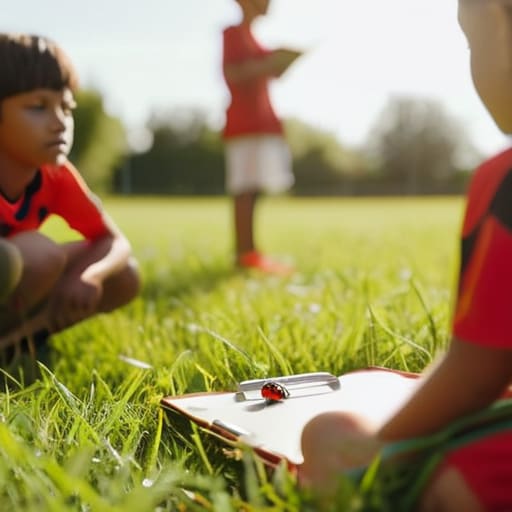
I see it every weekend: a coach standing there with a clipboard, trying to explain “spatial awareness” or “triangulation” to a group of seven-year-olds who are currently more interested in a ladybird crawling across the touchline. You can talk all you want about the high-level theory of youth player development stages, but if you’re lecturing them like they’re at a seminar, you’ve already lost them. At this age, they don’t have the cognitive capacity to process abstract tactical concepts. They aren’t little adults; they are kids who want to kick a ball and see what happens.
If you want to see real progress, you have to focus on age-appropriate skill acquisition through movement, not lectures. This means moving away from the “follow the leader” lines where kids stand around waiting for their turn to touch the ball. Instead, use drills that keep them moving constantly. If a drill requires more than ten seconds of explanation, it’s too complicated. Your job isn’t to teach them a system; it’s to make sure they fall in love with the ball so they actually want to come back next Tuesday.
Managing Child Psychology in Sports Without Losing Control
Look, you can have the most sophisticated tactical session planned out on a whiteboard, but if you haven’t accounted for the fact that seven-year-old Leo is currently upset because he lost his left shin guard, your session is dead in the water. At this level, you aren’t just a coach; you’re a part-time negotiator and a full-time distraction manager. Managing child psychology in sports isn’t about deep psychological theory; it’s about recognizing that their attention spans are shorter than a referee’s patience in a thunderstorm. If you spend ten minutes explaining a concept, you haven’t coached them—you’ve just given them a chance to stare at a passing cloud.
The secret is to stop treating them like miniature professionals and start understanding the actual youth player development stages. They don’t need a lecture; they need constant, small wins. Instead of a heavy-handed critique when they miss a pass, use subtle positive reinforcement coaching techniques. If you shout “Don’t do that again,” they’ll shut down. If you say, “I liked how you looked up before you kicked it, even if it went wide,” you’ve actually given them something to hold onto. Keep the energy high, keep the instructions brief, and for heaven’s sake, keep them moving.
Five Truths for the Sunday Morning Trenches
- Stop the “Lines and Cones” Madness. If you have twelve kids standing in a queue waiting for their turn to kick a ball at a single cone, you aren’t coaching; you’re babysitting. At this age, they need touches. If they aren’t touching the ball every thirty seconds, they’ll start wrestling each other or looking at the clouds. Keep them moving, or lose them.
- Forget the Tactical Board. You can talk about “transitioning from defense to attack” until you’re blue in the face, but an eight-year-old doesn’t know what that means. They know where the ball is, and they want it. Teach them to find space by making it a game of “finding the islands,” not by explaining positional geometry.
- The “Why” Must Be Physical, Not Theoretical. Don’t tell them to “keep their head up to scan the field.” Tell them to “look for the teammate who isn’t being hugged by a defender.” Give them a concrete reason to do something, or it simply won’t stick when the adrenaline hits.
- Respect the Parent Factor as Much as the Player. Half your battle isn’t the kids; it’s the sideline. If you don’t set the tone in the first five minutes—explaining that this is about development, not winning the Champions League by next Tuesday—you’ll spend the whole season fighting a war of attrition with parents who think every corner kick is a life-or-death situation.
- Condition Them Through the Game, Not the Drill. I see coaches running laps or doing shuttle sprints to “build fitness.” It’s a waste of precious time. If you want them fit, play small-sided games with high intensity. If they’re playing, they’re moving. If they’re moving, they’re getting better. Everything else is just making them bored and tired before the whistle even blows.
The Three Things You’ll Actually Need on a Sunday Morning
Stop chasing “tactical awareness” with seven-year-olds; they don’t need to understand a 4-3-3, they just need to learn how to keep their heads up while running with the ball.
If your drill requires a whiteboard and a twenty-minute explanation, you’ve already lost them—keep the instructions to thirty seconds and get them moving before the frost sets in.
Connection beats coaching every single time; if you haven’t built enough trust that they’ll listen when it’s raining and they’re tired, no amount of fancy technical instruction will stick.
The Sunday Morning Reality Check
Look, if you’ve followed anything I’ve said so far, you know I’m not interested in your fancy tactical boards or your high-concept philosophies that fall apart the moment a kid starts crying because he lost his shin guard. We’ve talked about keeping the drills simple enough to survive a gust of wind, managing the temperaments of nine-year-olds who would rather be playing video games, and focusing on actual ball mastery rather than trying to teach them a high press they aren’t physically capable of sustaining. At the end of the day, coaching under-tens isn’t about producing the next Premier League superstar; it’s about making sure they actually want to come back next week and that they leave the pitch with a slightly better touch than they arrived with.
Don’t let the pressure of the “development pathway” get in your head. You aren’t building a professional athlete; you are tending a garden. Some weeks the sun shines and the drills flow perfectly; other weeks, you’re standing in a puddle, shouting over the wind, wondering why nobody is listening. That’s fine. If you can provide a space where they feel safe enough to make a mistake without looking at the ground in shame, you have already won. Just keep showing up, keep the instructions brief, and for heaven’s sake, make sure they’re actually having a bit of fun. That’s the only thing that truly lasts.
Frequently Asked Questions
How do I keep a drill going when half the group is distracted by a passing butterfly or their own shoelaces?
Stop trying to lecture them. If you’re standing there with a whistle and a clipboard explaining the “spatial mechanics” of a drill while they’re staring at a butterfly, you’ve already lost. The drill is too long, or it’s too static. If they’re fidgeting, it’s because they aren’t moving. Shorten the setup, increase the repetitions, and get the ball under their feet immediately. If they aren’t touching the ball, they aren’t learning; they’re just waiting for you to finish talking.
When do I stop focusing on individual ball mastery and actually start teaching them how to play as a team?
You don’t “stop” one to start the other; you layer them. If you stop the ball mastery too early, you’re just teaching them to pass a heavy object around like a bunch of lost sheep. But if you never introduce spacing or support, they’ll never see the pitch. Start introducing small-sided games where they have to find a teammate to keep possession. Let them master the ball individually, then show them why it’s more useful when shared.
How am I supposed to manage the parents on the sidelines who think they’re the tactical geniuses?
Look, I’ve been there. You’re trying to explain a simple transition to a ten-year-old, and there’s a man in a puffer jacket behind the goal shouting, “Get it wide!” like he’s Pep Guardiola.
